
Stablecoins and Real Estate Tokenization: How On-Chain Payments Work
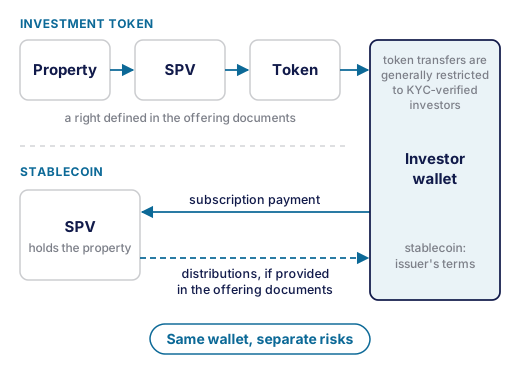
In tokenized real estate, the stablecoin is how you pay and the real estate token is what you own. A stablecoin moves value between wallets; an investment token represents a right tied to a property, defined in the offering documents. Keeping the two apart tells you where each risk sits.
Both are tokens, both sit in the same wallet, and both move on the same blockchain. That is exactly why they are easy to confuse. This article explains what a stablecoin does in a tokenized real estate transaction, how it is used for subscriptions, payouts and settlement, what to know about wallets, and which risks belong to the stablecoin rather than to the property.
What is a stablecoin?
A stablecoin is a token designed to keep a stable value relative to a reference asset, most commonly the US dollar. Most widely used stablecoins are issued by a company that holds reserve assets and undertakes to redeem the tokens under its terms. USDC is one example.
A stablecoin is not an investment in anything beyond that promise of stable value and redemption. It does not represent a share in a building, a company or a lease. It is a means of payment that happens to live on a blockchain, which lets it move in the same system as the tokens it is used to buy. For how EU law classifies stablecoins, see our article on MiCA and tokenized real estate.
Stablecoin vs investment token: what is the difference?
| Stablecoin (payment means) | Real estate investment token (right to an asset) | |
|---|---|---|
| Purpose | Pay, receive and move value | Represent an interest in a property structure |
| What stands behind it | The issuer’s reserves and redemption terms | The rights defined in the offering documents, usually in an entity (SPV) that holds the property |
| Expected value behavior | Designed to stay stable | Can go up or down with the property and its income |
| Who can hold it | Generally transferable between wallets, subject to the issuer’s terms | Transfers are generally restricted to KYC-verified investors |
| Where rights are defined | The stablecoin issuer’s terms | The offering documents of the specific property |
| Main risks | Issuer, reserves, loss of the peg, technical | Property, legal structure, liquidity, market |
The key line in this table is the last one. A stablecoin and a real estate token can sit side by side in one wallet, but their risks are completely separate. A stable stablecoin says nothing about the property, and a strong property says nothing about the stablecoin. For more on what an investment token represents, see What are security tokens? and What are RWA tokens?.
How are stablecoins used in tokenized real estate?
Stablecoins can appear at four points in the life of an investment. Which of them apply depends on the platform and the offering documents.
- Subscription. After completing identity verification, an investor pays for tokens with a stablecoin sent from a wallet, or with a traditional bank transfer where the platform offers one. Tokens are then allocated to the investor’s verified wallet under the terms of the offering.
- Settlement. On-chain, the transfer of the token and the stablecoin payment can be recorded together. Where both legs settle in one operation (known as delivery versus payment), neither side has to trust the other to deliver first. Not every platform settles this way, so it is worth asking.
- Distributions. If the offering documents provide for income participation, distributions can be paid in a stablecoin directly to token holders’ wallets. The stablecoin is only the payment channel; whether there is anything to distribute depends on the property and the terms.
- Exit. If the property is sold or tokens are redeemed under the offering documents, proceeds can also be paid in a stablecoin.
Why use stablecoins at all?
Stablecoins are used because they move on the same rails as the investment token. That brings practical advantages:
- On-chain settlement. Payment and token transfer can be recorded on the same ledger, without manual reconciliation between separate systems. We explain this mechanism in how blockchain changes real estate.
- Direct distributions. Payouts can reach many holders’ wallets at once, including self-custodial wallets.
- A verifiable record. Every payment is visible on the blockchain, so an investor can match what was paid against what the documents say.
- Availability. Blockchain transfers are not tied to banking hours.
None of this changes the economics of the property. It changes the plumbing.
What should you know about wallets?
A wallet that holds your real estate token can usually hold stablecoins too, but a few practical rules apply:
- Same network. A stablecoin exists on several blockchains. To receive or send it, you need the version on the network the platform uses. Sending tokens on the wrong network or to a wrong address is often irreversible.
- Different transfer rules. Transfers of your investment token are generally restricted to KYC-verified investors. The stablecoin in the same wallet generally follows the issuer’s terms instead. Do not assume one token’s rules apply to the other.
- Custody is your choice, and your responsibility. With a self-custodial wallet, you control the keys; if you lose them, no one can restore access for you. Managed accounts reduce that burden but add a dependency on the provider.
What are the risks of stablecoins?
Stablecoins are widely used, and describing their risks is not a warning against them. It is part of understanding what you hold between payment and investment.
- Issuer and reserve risk. A stablecoin is only as good as its issuer’s reserves and its ability and willingness to redeem. Check which entity issues it, what the reserves consist of and how often the issuer publishes reserve reports.
- Loss of the peg (“depeg”). The market price of a stablecoin can move away from its reference value, usually briefly and usually during market stress. The issuer’s redemption terms and reserves determine how and whether the peg recovers.
- Issuer controls. Many issuers reserve the right in their terms to block addresses and freeze tokens, for example in connection with illegal activity or legal orders. This is part of how stablecoins meet legal obligations, but it means the issuer’s terms matter.
- Technical risk. Stablecoins run on smart contracts and blockchains. Network outages, contract issues or user mistakes (wrong address, lost keys) can affect access to funds.
- Legal treatment differs by jurisdiction. The rules that apply to stablecoin issuers are not the same everywhere, and they continue to develop.
All five are risks of the payment means. They sit next to, not inside, the risks of the property itself: occupancy, lease terms, valuation, legal structure and liquidity. A complete picture needs both.
How does this work on Stockenn?
On Stockenn, investors can pay with a bank transfer in USD or crypto (USDC), and payouts are made in USDC. Tokens are recorded on Polygon, and self-custodial wallets are supported alongside standard accounts; see how it works for the full process.
Review offerings and documents on Stockenn →
Frequently asked questions
Is a stablecoin the same as a real estate token? No. A stablecoin is a means of payment designed to keep a stable value, while a real estate token represents a right tied to a property, defined in the offering documents. They can sit in the same wallet but carry different risks.
Why are tokenized real estate distributions often paid in stablecoins? Because stablecoins move on the same blockchain as the investment tokens, distributions can be sent directly to holders’ wallets and recorded on-chain. Whether any distribution is made depends on the property and the offering documents, not on the stablecoin.
Can a stablecoin lose its value? It can. A stablecoin’s market price can temporarily move away from its reference value, and its value ultimately depends on the issuer’s reserves and redemption terms. That is why it is worth knowing who issues the stablecoin you use.
Do I need crypto to invest in tokenized real estate? Not always. Some platforms, like Stockenn, accept traditional bank transfers as well as stablecoins, and some let you use a standard account without managing a crypto wallet yourself from day one. Technologies such as account abstraction can make the experience even more familiar by allowing blockchain-based accounts to work more like regular online accounts, while the platform handles much of the technical complexity in the background. Depending on the platform, you may still have the option to use your own self-custodial wallet if you prefer.
Does being paid in a stablecoin make income more certain? No. The stablecoin only determines how a payment is delivered. Whether income is paid, and how much, depends on the property’s performance and on the rights set out in the offering documents.