
What Happens When a Tokenized Property Is Sold? The Exit, Step by Step
When a tokenized property is sold, the entity that holds it (usually an SPV) sells the building, pays transaction costs, taxes and its own liabilities, and distributes what remains to token holders in proportion to their holdings, as the offering documents define. The tokens are then typically redeemed and permanently removed from circulation, and the SPV is wound up. The blockchain records who is entitled to what; the legal documents decide how the sale happens and who gets paid first.
Most investors think about the entry: which property, which offering, how many tokens. The exit deserves the same attention before you invest, because it is the moment when your rights are turned back into money. This article walks through that moment step by step and ends with the questions to ask before you commit.
Who decides to sell a tokenized property?
A token holder does not own the building directly. In most structures, the property is held by a special purpose vehicle (SPV), and the tokens represent interests in that entity or rights defined in the offering documents. So the decision to sell belongs to whoever the documents give that power to. Common models include:
- The manager decides. The SPV’s manager or asset manager may sell within a planned holding period or when set conditions are met.
- Token holders vote. Some offerings require a vote of token holders, often with a defined majority, before the asset can be sold.
- A planned horizon. Some offerings state an intended holding period at the start, with the sale as the expected exit.
- A mix of the above. For example, the manager proposes a sale and token holders approve it.
None of these is better by default. What matters is that the offering documents say clearly who decides, on what conditions, and whether token holders have any say.
The exit, step by step
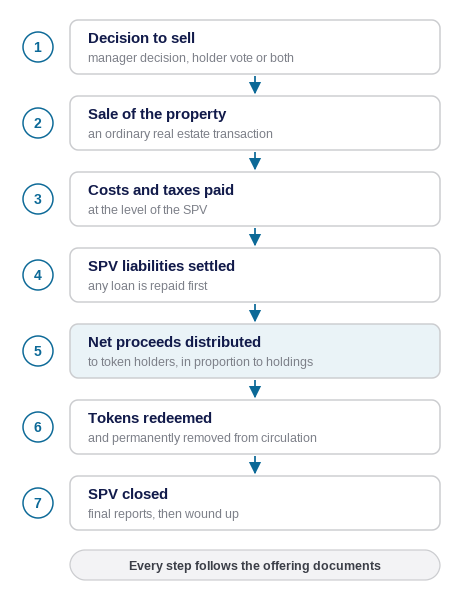
- Decision to sell. The sale is approved under the governance rules in the offering documents (manager decision, holder vote or both).
- Marketing and sale of the property. The SPV finds a buyer and sells the building through a normal real estate transaction. Tokenization does not change this part: the buyer acquires a building (or the SPV itself) under ordinary property law.
- Transaction costs and taxes. The SPV pays the costs of the sale (for example legal work, agents, notary or registration costs, depending on the jurisdiction) and any taxes due at the level of the entity.
- Settling liabilities. If the SPV has a loan secured on the property, it is repaid first. Other obligations of the entity (service providers, reserves, final accounting) are settled as well.
- Distribution of net proceeds. What remains is distributed to token holders, usually in proportion to the number of tokens each holds, in the form and on the terms set by the offering documents.
- Redemption or permanent removal of tokens from circulation. Once holders are paid, the tokens have no remaining underlying asset. They are typically redeemed, burned (permanently removed from circulation on-chain) or frozen, so that the on-chain register matches reality.
- Closing the SPV. The entity files its final reports and is wound up.
Timelines vary widely. A commercial property sale can take months, and the final distribution may come only after accounts are closed. Treat any exit as a process, not an event.
What is deducted before token holders are paid?
The sale price of the building is not the amount token holders receive. Between the two sit several layers, and each one should be described in the documents:
| Layer | What it covers | Where to check |
|---|---|---|
| Transaction costs | Legal work, agents, registration and other costs of selling a property | Offering documents, SPV budget |
| Taxes | Taxes due at the level of the SPV on the sale, depending on the jurisdiction | Offering documents, tax section |
| Debt | Repayment of any loan secured on the property | Financing section of the documents |
| Other liabilities | Obligations of the SPV, reserves, winding-up costs | SPV documents, distribution terms |
| Order of payment | Whether any class of investors or creditors is paid first | Distribution rules (“waterfall”) |
Leverage matters here in both directions. A loan allows a larger property per invested dollar, but it is repaid before any distribution, so it reduces what is left for token holders if the sale price is lower than expected. This is one reason why the sale price and the amount per token can move differently.
How are the proceeds distributed to token holders?
The on-chain register is what makes this step clean. At a defined moment, the list of token holders and their balances is fixed (a “snapshot”), and the distribution is calculated from it. Every holder can check their own balance on the blockchain, and the total token supply is publicly visible, so there is no question of how many interests exist.
What the blockchain does not decide is the amount. The amount comes from the sale result and the distribution rules in the offering documents. If the property sells well, the distribution may be higher than the amount invested; if it sells poorly, token holders can receive less than they invested. Nothing in the tokenization process protects the outcome. For how income and value changes fit together over the life of an investment, see how investors earn from tokenized real estate.
What happens to your tokens after the sale?
After the final distribution, a token without an underlying asset has no purpose. Offerings typically deal with this in one of three ways:
- Redemption. Tokens are returned to the issuer in exchange for the final payment.
- Burn. Tokens are permanently removed from circulation on-chain, which is publicly verifiable.
- Freeze. Transfers are disabled so the tokens can no longer change hands.
One practical point: you need access to the wallet or account that holds your tokens at the moment of the snapshot and payout. If you use a self-custodial wallet, keep your recovery details safe for the full life of the investment, not just the first months.
What about taxes on the sale?
Taxes can arise at two levels: at the SPV when it sells the building, and at your level when you receive the final distribution or dispose of your tokens. How each is treated depends on your jurisdiction, the jurisdiction of the property and the SPV, and the structure described in the offering documents. There is no single answer, and this article does not give tax advice. Keep records of what you paid and received, and consult a tax professional about your own situation.
Selling the property vs selling your tokens
These are two different exits, and they are easy to confuse:
| Sale of the property | Sale of your tokens | |
|---|---|---|
| Who acts | The SPV, under the governance rules | You, individually |
| What is sold | The building (or the SPV) | Your interest, to another verified investor |
| Price based on | The property market | What a buyer is willing to pay for the token |
| Depends on | Offering documents, market conditions | Transfer rules, a buyer, a functioning secondary market |
Selling your tokens before the property is sold depends on transfer rules and on finding a buyer. We explain the difference between transferability and liquidity in liquidity in tokenized real estate.
What to check in the offering documents before you invest
- Who decides on the sale and whether token holders vote.
- Intended holding period, if any, and what happens if it is extended.
- Debt: whether the SPV borrows, and on what terms.
- Distribution rules: order of payment, form of payment, timing.
- Token redemption: what happens to the tokens at the end.
- Wind-up: how and when the SPV is closed, and who reports to investors.
If the documents are vague on any of these points, ask before investing. On Stockenn, the secondary market will launch at a later stage, so reading each offering’s exit provisions before you invest is especially worthwhile.
Review offerings and documents on Stockenn →
Frequently asked questions
What happens to my tokens when the property is sold? They are typically redeemed, burned or frozen after the final distribution, because they no longer have an underlying asset. The exact mechanism is set out in the offering documents.
Do I get my money back when a tokenized property is sold? You receive your share of the net proceeds, which can be more or less than you invested. Net proceeds are what remains after transaction costs, taxes and the SPV’s liabilities, including any loan.
Can token holders stop a sale of the property? Only if the offering documents give them that right, for example through a holder vote. In some structures, the manager decides within set conditions without a vote.
How long does the exit take? It depends on the property market and the structure. The sale itself can take months, and the final distribution may follow only after the SPV settles its liabilities and closes its accounts.
Do I pay tax when a tokenized property is sold? Tax treatment varies by jurisdiction and by the legal structure of the investment. Depending on your circumstances, a sale or distribution may have tax implications, so it is worth checking the rules that apply to you in your country of tax residence.