
How Do You Make Money From Tokenized Real Estate? Sources of Return, Risks and Where Your Money Goes
Tokenized real estate can produce a return in up to four ways: distributions of rental income, a change in the property’s value, proceeds from a sale of the property, and selling your tokens to another investor where a secondary market exists. Which of these apply depends on the rights set out in the offering documents, and none of them is guaranteed. Each source also has a risk attached, and it is worth knowing both before you invest.
A token does not earn anything by itself. It is a digital record of a legal right, usually an interest in a special purpose vehicle (SPV) that holds the property. Whatever the investor may receive comes from the building and its lessees, flows through that legal structure, and reaches token holders only on the terms the documents define. So the first question is not “how much?” but “what does my token entitle me to?”
What are the possible sources of return?
| Source | How it can work | The risk beside it | Where to check |
|---|---|---|---|
| Rental income distributions | Lessees pay rent to the SPV; if the token carries income rights, distributable amounts can be paid to token holders | Vacancies, lessee defaults or lower rents reduce or stop distributions | Token rights and distribution terms in the offering documents |
| Change in property value | The value of the interest behind your token can rise or fall with the property | Values can fall as well as rise | Valuation reports, investor updates |
| Sale of the property (exit) | If the SPV sells the asset, net proceeds can be distributed to token holders | Timing and price are uncertain; the sale may happen at a loss | Exit provisions in the offering documents |
| Selling tokens to another investor | Where a secondary market exists, you may sell tokens to a buyer | There may be no buyer, or only at a lower price | Transfer rules, secondary market status |
The sections below look at each source in turn.
How can rental income reach token holders?
Rental income is the most direct link between the building and the investor. The lessees pay rent to the property-holding entity. If the token’s rights include participation in income, the SPV can pass on distributable amounts to token holders, in proportion to their holdings and on the schedule set in the offering documents.
Three things decide whether this happens and how:
- The rights attached to the token. Not every token carries income rights. Our guide to what a real estate token represents explains the main types.
- The distribution terms. The documents define what counts as distributable, how often distributions can be made, and under what conditions they may be paused.
- The property itself. Occupancy, lease terms and lessee strength drive the rent. Lease obligations do not depend on crypto market phases, but a lessee can still leave or fail to pay.
The risk: distributions are never a fixed promise. If rent falls or the SPV needs cash for other obligations, distributions can be lower or may not be made at all.
Can the property’s value work for you, or against you?
The economic value of your token is linked to the value of the property behind it. If the property becomes more valuable, for example because leases are extended or the location improves, the interest your token represents can become more valuable too.
The risk: the same link works in reverse. Rising vacancies, weaker demand or broader market conditions can push the value down. A change in value is also only realized when something happens: the property is sold, or you sell your tokens.
What happens to your investment when the property is sold?
Many offerings are designed around an eventual sale of the property. If the SPV sells the asset, the proceeds remaining after its obligations are settled can be distributed to token holders according to the offering documents, after which the tokens are typically redeemed.
The risk: you do not control the timing or the price. A sale can take longer than planned, and it can happen at a lower value than the original purchase.
Can you earn by selling your tokens to another investor?
Tokens make transfers technically simpler than traditional fractional structures. Where a secondary market exists, you may be able to sell your tokens to another investor, and the price you get may be higher or lower than what you paid.
The risk: transferability is not the same as liquidity. Many offerings restrict transfers to KYC-verified investors, and a sale needs a willing buyer. Secondary markets for tokenized real estate are still developing. Our article on liquidity in tokenized real estate explains the difference in detail.
Where does your money actually go?
Knowing the flow of money is the best protection against misunderstanding what you bought. In a typical SPV-based structure, it moves in a loop:
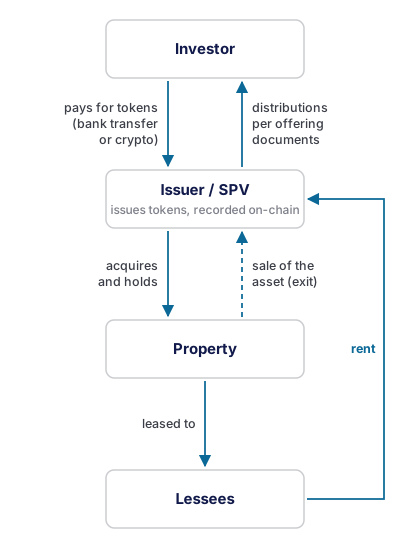
Step by step:
- You pay for tokens. Your payment goes to the issuer, typically the SPV or an entity acting for it, not to a pool of unrelated projects.
- The SPV holds the property. The money raised is used as the offering documents describe, for example to acquire or refinance the specific property.
- Your tokens are recorded on-chain. The blockchain shows which wallet holds which tokens; the offering documents define what those tokens mean legally.
- Lessees pay rent to the SPV. The property, not the platform, is the source of income.
- The SPV makes distributions if the documents provide for them. Amounts defined as distributable can be paid to token holders in proportion to their holdings.
- At exit, the loop closes. If the property is sold, the remaining proceeds can be distributed and the tokens redeemed.
This is why the SPV matters so much. It is the entity that holds title, collects rent and makes any payments. See how SPVs work in real estate tokenization.
What should you check before counting on any return?
- Token rights: does the token carry income rights, value participation, or both?
- Distribution terms: what is distributable, how often, and when can distributions stop?
- The property: occupancy, lease terms, lessee profile and any debt.
- Exit provisions: is a sale of the property planned, and who decides?
- Taxes: income and gains may be taxable where you live. Keep records and consult a professional.
If the offering shows any projections, read the assumptions behind them and ask how sensitive they are to vacancies.
How this works on Stockenn
On Stockenn, payouts are made in USDC, and the rights attached to each token are set out in that offering’s documents. Read them before investing.
Review offerings and documents on Stockenn →
Frequently asked questions
Is income from tokenized real estate guaranteed? No. Any distributions depend on the rights in the offering documents and on the property’s actual rental income. Vacancies or lessee defaults can reduce or stop them.
Where does the income in tokenized real estate come from? From the property itself, mainly rent paid by lessees to the SPV that holds it. The token is a record of your rights; it does not generate income on its own.
Do all real estate tokens pay distributions? No. Some tokens carry income rights, others represent different types of claims. Check what your token represents before assuming it pays anything.
Can I lose money in tokenized real estate? Yes. Like any other investment, tokenized real estate involves risk, and you may lose some or all of the money you invest. Property values can fall, rental income can decline, and you may not find a buyer for your tokens when you want to sell. Invest only money you will not need in the near term.
How are distributions paid? Through the method set out in the offering documents, usually to your platform account or wallet. On Stockenn, payouts are made in USDC.