
What Does a Real Estate Token Represent? Rights, Proof and What to Check
A real estate token represents the rights written into an offering’s legal documents - most often a share or economic interest in the legal entity that owns a property, not the property itself. The token is the record of your position; the documents define what that position means legally.
That distinction sounds technical, but it decides almost everything that matters to an investor: what you can claim, against whom, and what happens if something goes wrong. Two tokens on the same blockchain, built on the same technical standard, can represent completely different things. This guide explains the five types of rights a real estate token can carry, where the proof of your ownership actually lives, and how to tell which type you are looking at before you invest.
Is a real estate token the same as owning a property?
No. A token is a digital entry on a blockchain. On its own, it is a record that a particular wallet holds a particular number of units. What those units mean is defined off-chain, in legal documents: the constitutional documents of the issuing entity, the offering terms, and any agreements between the issuer and investors.
This is why the common shortcut - “you own a piece of the building” - is usually imprecise. In most tokenized real estate structures, the building is owned by a company created for that purpose, and the token represents an interest in that company. You are exposed to the economics of the property, and you may have rights connected to it, but your name does not appear in the land registry.
That is not a weakness in itself. Indirect ownership through a legal entity is how many large real estate investments have long worked, from fund units to company shares. The point is to know which structure you are buying, because each one carries different rights and different risks. For the broader picture, see our guide to real estate tokenization.
What rights can a real estate token carry?
Most real estate tokens fall into one of five categories. The labels vary between jurisdictions and issuers, so always read what the documents say rather than what the marketing calls the token.
| Type of right | What you have | What you do not have | Where to check |
|---|---|---|---|
| Direct ownership (rare) | A fractional share in the property title itself, where local law allows it to be recorded this way | A simple way to transfer title by token alone; land registry formalities still apply | Land registry extract, transfer documents, legal opinion on how the token links to the title |
| Interest in an SPV (most common) | Shares or an economic interest in the entity that owns the property; participation in its income and in sale proceeds, if the documents provide for it | Direct title to the building; a claim against the property outside the entity | The SPV’s constitutional documents, offering documents, the entity’s register |
| Debt | A claim to repayment of a loan to the property owner, with interest if the documents provide for it | A share in the property’s value growth; ownership | Loan or note terms: repayment schedule, ranking, any collateral |
| Profit or revenue participation | A contractual share of income or profit, defined by a formula | Ownership, and often any say in decisions | Participation agreement: how income is calculated, what is deducted first, how long the right lasts |
| Other contractual rights | Rights defined only by a contract with the issuer, for example a future purchase option | Anything the contract does not spell out | The contract itself and the identity of the counterparty |
A few observations from the table:
- Direct title tokenization is rare, because in most legal systems property ownership is recorded in a public land registry, and a transfer requires formalities that a blockchain transaction does not replace on its own.
- SPV interests dominate, because they separate the asset from other risks and allow ownership of an entity to be divided into many units.
- Debt and participation tokens are not “worse” - they are different. A debt token has a different risk profile than an equity interest; a participation token depends heavily on how income is defined.
- Contractual rights are only as strong as the counterparty. If a right exists only in a contract with one company, your position depends on that company.
Why do most real estate tokens represent an SPV interest?
A special purpose vehicle (SPV) is a legal entity whose only job is to hold one asset. Putting the property in an SPV achieves three things at once: the asset is isolated from the sponsor’s other businesses, ownership of the entity can be divided into many units, and there is one clearly identifiable party that holds the title, signs the leases with lessees and can be held to its obligations.
The token then maps to units of that entity. When the documents say a token represents one unit of the SPV’s equity, the chain of rights is short and checkable: token, SPV interest, property owned by the SPV. We explain this structure step by step in how SPVs work in real estate tokenization.
What is the proof of fractional property ownership?
This is one of the most frequent questions about tokenization, and the honest answer is: the proof lives in two places, and you need both.
- The on-chain record shows that your wallet holds a given number of tokens. It is public, time-stamped and very hard to alter retroactively. Anyone can verify it without asking the platform.
- The legal documents establish what those tokens mean: which entity issued them, what rights attach to each unit, and how the holder of a token is recognized as the holder of those rights.
Behind the entity sits a third layer from the traditional world: the land registry, which shows that the SPV, and not someone else, owns the property.
Proof of fractional ownership is therefore a chain. The land registry links the property to the SPV. The SPV’s documents link the SPV to its units. The offering documents link the units to the tokens. The blockchain links the tokens to your wallet. If any link is missing or vague, the chain is weaker than it looks, no matter how clean the on-chain record is.
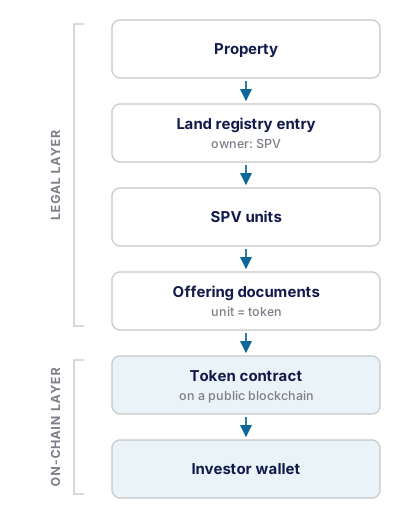
A practical consequence: the on-chain record persists even if a platform disappears, but your legal claim depends on the documents. We cover that scenario in detail in what happens if a tokenization platform fails.
How can you tell what a specific token represents?
Before investing in any tokenized property, answer these questions from the documents, not from the product page:
- Who is the issuer? Name, jurisdiction and registration of the entity that issued the tokens.
- Who owns the property? The issuer itself, an SPV below the issuer, or a third party?
- What is one token? A unit of equity, a portion of a loan, a share of income, or a contractual right?
- What does the token entitle you to? Income participation, sale proceeds, information rights, voting - and under which conditions.
- What does the token not give you? Look for what is missing as carefully as for what is included.
- How is the holder recognized? Is the on-chain register the official record of holders, or do the documents treat a separate register as decisive?
- Who can receive the token? Many offerings restrict transfers to KYC-verified investors. The rules follow from the law and the offering documents, and the platform enforces them.
If the answers are hard to find, that is information too. Credible offerings make their documents available before you commit. For a wider checklist that covers the platform itself, see is tokenized real estate safe?
What does a Stockenn token represent?
Tokens offered by Stockenn are a legal representation of shares in the entities that own the underlying properties, and the offering documents define exactly what rights each token carries. The structure is described on our security page.