
What Happens If a Tokenization Platform Fails? What Survives and What to Check
If a tokenization platform fails, the first thing you lose is the interface - not necessarily your investment. What survives depends on four separate layers: the platform, the issuer, the SPV that owns the property, and the on-chain register of token holders. The offering documents decide how much of the structure keeps working without the platform.
“What if the website disappears?” is one of the most reasonable questions an investor can ask about tokenized real estate. Our article on whether tokenized real estate is safe answers it in two sentences. This article goes deeper: it separates the layers that are often blurred into “the platform”, walks through a failure scenario step by step, and lists the questions to ask before you invest.
Why is “the platform” not one thing?
From the investor’s side, everything happens in one app: you sign up, verify your identity, invest, see your tokens and receive updates. Behind that screen there are usually four distinct layers, often run by different legal entities.
| Layer | What it does | If it fails | What to check |
|---|---|---|---|
| Platform | Interface, onboarding, KYC/AML checks, investor communication, often administration of the token register | You lose the usual way to see and manage your investment | Whether the documents provide for a replacement administrator |
| Issuer | The legal entity that issued the tokens and owes obligations to holders | Obligations to token holders may be disrupted | Identity, jurisdiction, and separation of the issuer from the platform |
| SPV | The entity that owns the property, signs leases and receives income | Property-level risk: the asset itself is affected | Debt, management, ring-fencing, governance rights |
| On-chain register | The public record of which wallet holds how many tokens | A public blockchain is not operated by the platform, so the record does not disappear with it | Which blockchain, which token contract, who controls its administrative functions |
The key insight: a platform failure and a property failure are different events. A platform failure is an operational problem that a structure can be designed to survive. A property failure is investment risk that no platform can remove.
For more on the entity that owns the property, see how SPVs work in real estate tokenization.
What happens, step by step, if the platform shuts down?
Consider a well-structured offering in which only the platform company fails, while the issuer and the SPV remain intact. The sequence typically looks like this:
- The app goes offline. You can no longer log in to the usual dashboard. This is the most visible effect and, in a good structure, the least important one.
- The on-chain record remains. Your tokens are still in your wallet and are still recorded on the public blockchain. Anyone, including you, can verify the holding in a block explorer using your wallet address and the token contract address.
- The SPV still owns the property. The land registry still shows the SPV as owner. Lease agreements are contracts between the SPV and its lessees, not between lessees and a website. Lease obligations do not depend on whether an app is online.
- Someone must take over administration. Keeping holder records, running verification checks for transfers, preparing distributions and reporting all require an operator. Whether a replacement is appointed, by whom and how quickly depends on the offering and SPV documents.
- Distributions may pause. Even if the property keeps generating income, payments to token holders need someone with authority to make them. Delays are possible during a transition.
- Transfers may pause. Many offerings restrict transfers to KYC-verified investors, so transfers need a working verification process. The rules follow from the law and the offering documents, and the platform, or its replacement, enforces them.
- Your legal claim remains. Your rights come from the documents, not from the app. Holders can assert them against the issuer and the SPV through the governance and legal routes the documents provide.
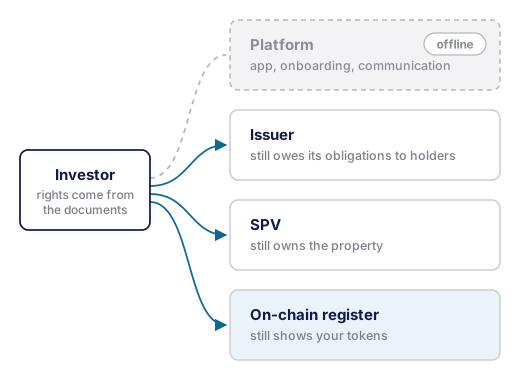
That is the good scenario. It rests on assumptions you should verify rather than take for granted.
What if the issuer or the SPV fails instead?
These are different, and more serious, situations.
- If the SPV fails, for example because the property’s income cannot cover its debts, the problem is the asset itself. Creditors of the SPV, such as a lender with security over the property, are typically repaid before equity holders. The on-chain record will still show your tokens, but what they are worth depends on what remains after the SPV’s obligations.
- If the issuer fails, and the issuer is the same company as the platform, the separation between layers becomes the critical question. Structures in which the issuer, the platform and the property owner are distinct and documented are easier to protect than structures in which one company holds everything.
This is why the layers matter: a failure in one layer should stay in that layer. Our guide to what a real estate token represents explains how to trace the chain of rights from your wallet to the property.
What depends entirely on the documents?
Several things decide whether the good scenario holds, and none of them can be seen in the app:
- A replacement administrator. Do the documents name one, or describe how token holders can appoint one?
- Control of the token contract. Many token contracts have administrative functions, for example to manage the list of verified wallets. Who holds those rights, and what happens to them if the platform company is wound down?
- The official register of holders. Do the documents treat the on-chain register as the authoritative record of who holds rights, or is there a separate register kept by the platform?
- Investor data. KYC records are needed to recognize holders and process transfers. How would they be handed over, lawfully, to a successor?
- Governance rights. Can token holders vote to replace a manager or to sell the property, and how is a vote organized without the usual app?
- Wallet access. If you hold tokens in a self-custodial wallet, access to them does not depend on any company. If your account is set up through a standard platform login, ask how you would reach your tokens if the platform were unavailable.
What should you ask before investing?
Put these questions to any tokenization platform, or look for the answers in its documents:
- Which legal entities are the platform, the issuer and the property owner, and are they separate?
- What do the documents say happens if the platform stops operating?
- On which blockchain are the tokens recorded, and what is the token contract address?
- Is the on-chain register the authoritative record of holders?
- Can I hold the tokens in my own self-custodial wallet?
- What governance rights do token holders have if a manager or service provider must be replaced?
A credible platform will answer these without discomfort. Vague answers are a signal worth listening to.
How does this apply to Stockenn?
On Stockenn, self-custodial wallets are supported: experienced users can connect their own self-custodial wallet, and tokens are recorded on Polygon. The legal structure and investor protections are described on our security page.
Review offerings and documents on Stockenn →
Frequently asked questions
What happens to my tokens if a tokenization platform goes bankrupt? Your tokens remain recorded on the public blockchain, because the register does not depend on the platform’s servers. Whether your rights keep working in practice depends on the offering documents: who replaces the platform, and how distributions and transfers continue.
Do I lose my property investment if the platform shuts down? Not necessarily. In a well-structured offering, the property is owned by a separate SPV and your rights are defined in legal documents, so a platform shutdown is an operational disruption. The property’s own performance remains the main investment risk.
Can I see my tokens without the platform’s app? Yes, if they are recorded on a public blockchain. You can check your token holdings directly in your self-custodial wallet or independently verify them in a block explorer using your wallet address and the token contract address, which is why it is worth noting both when you invest.
Who makes distributions if the platform disappears? Distributions are made by or on behalf of the SPV or the issuer, not by the app itself. If the platform handled payments, the documents should say how a replacement takes over; until then, payments may be delayed.
Is a self-custodial wallet safer if a platform fails? It removes one dependency: access to your tokens does not rely on the platform’s login system. It also puts responsibility for the keys on you, so losing your recovery phrase can mean losing access.